@William Holder
For most buyers who can comfortably afford the monthly payment and plan to stay put for at least five years, now is a reasonable time to buy in the Philadelphia suburbs. Not because the market is easy — it isn't — but because waiting for a "perfect" moment usually costs more than it saves.
Here's the honest version: mortgage rates are high (low-to-mid 7% range as of early October 2026), prices are still inching up, and there aren't many homes for sale. That combination rewards buyers who are prepared and patient — not the ones trying to time the exact bottom.
What's actually happening in the market right now?
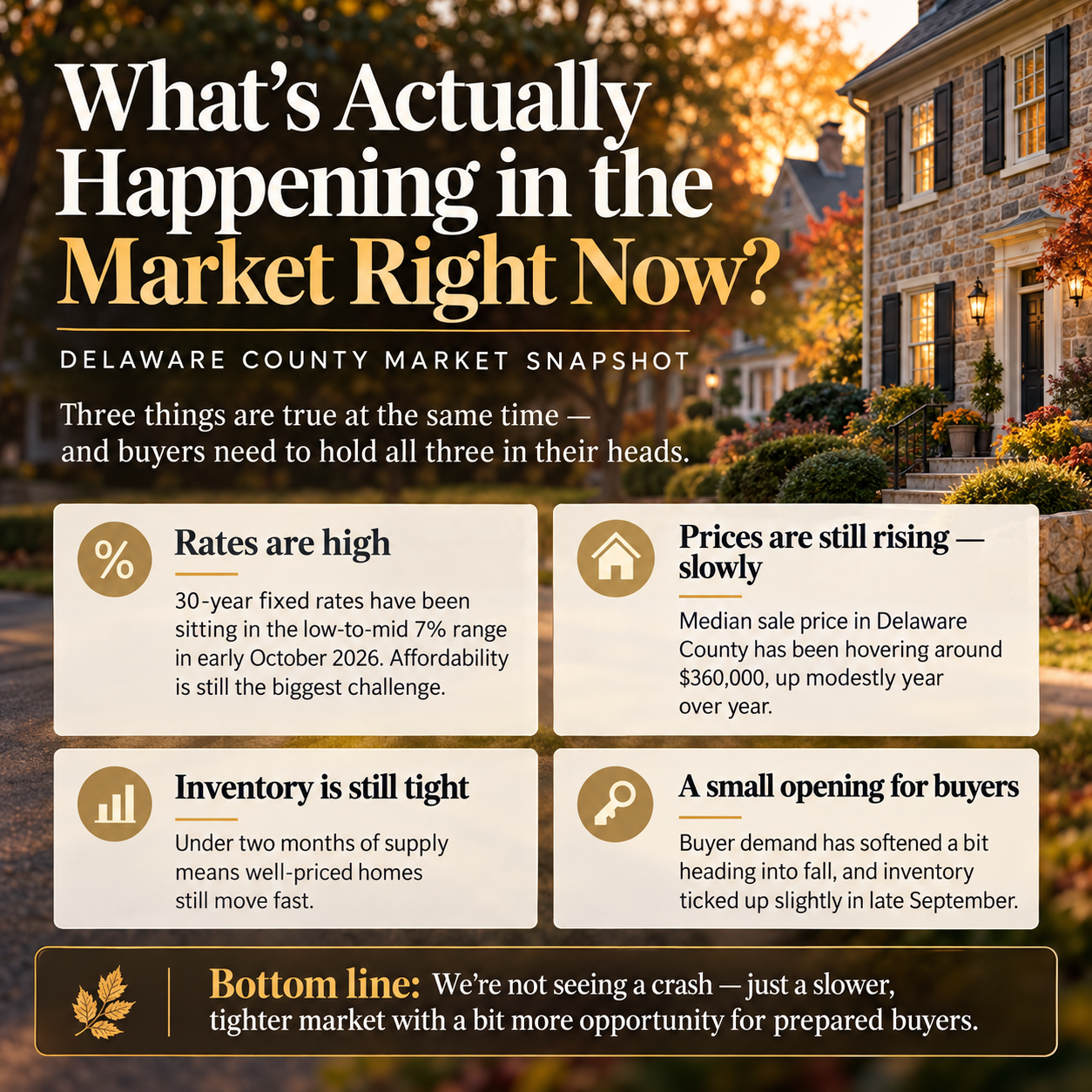
Three things are true at the same time, and buyers need to hold all three in their heads.
Rates are high. The 30-year fixed has been sitting in the low-to-mid 7% range in early October 2026 (Freddie Mac data) — roughly a full point higher than a year ago. That's the biggest thing weighing on affordability.
Prices are still rising, slowly. In Delaware County, the median sale price has been hovering around $360,000, up modestly year over year (Zillow). We're not seeing a price drop — just slower growth.
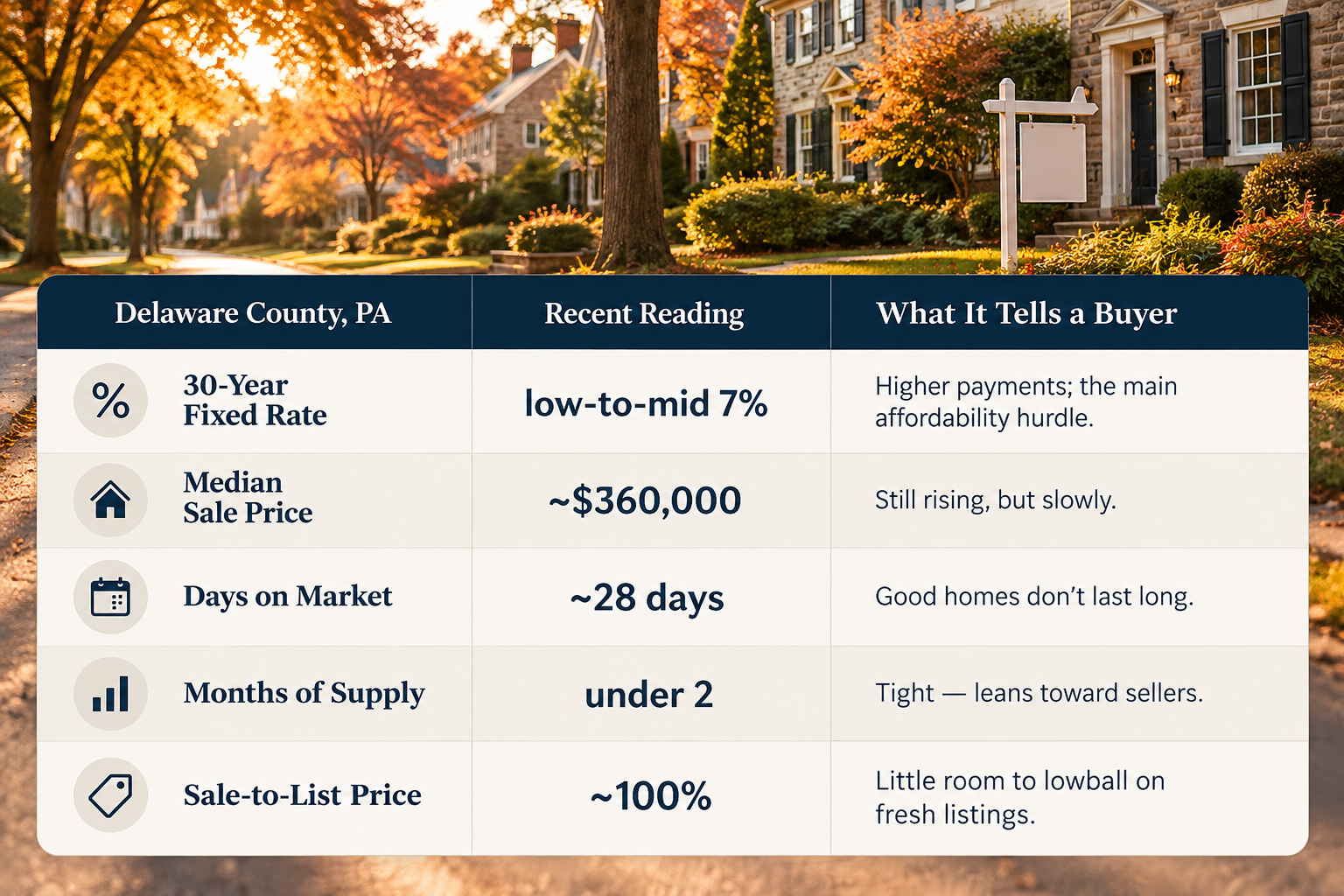
There still aren't many homes for sale. Inventory remains tight (under two months of supply), so well-priced homes move quickly — Delaware County has been averaging around 28 days on market, with homes selling right around their asking price (Bright MLS, week ending Sept 30, 2026).
Here's the snapshot:
The one shift worth noting: buyer demand has softened a bit heading into fall, and inventory ticked up slightly across the Philadelphia suburbs in late September. That's a small opening for buyers who are ready.
Should you buy now or wait for rates to drop?
This is the question I get most, so let me give you the honest answer: nobody knows where rates are going, and trying to time them is a losing game for most buyers.
Here's the part people miss. If rates drop, buying doesn't necessarily get easier — it often gets harder. Lower rates pull a wave of waiting buyers off the sidelines, competition heats up, and prices climb. You might save on the rate and give it right back in a higher price and a bidding war.
The old line is cheesy but true: you marry the house and date the rate. You can refinance a rate later. You can't go back and buy today's price later.
That doesn't mean everyone should buy right now. It depends on your situation.
It usually makes sense to wait if:
Your finances aren't ready — thin savings, high-interest debt, or shaky income
You might move again within two or three years
The only way to afford it is to stretch to the very top of your budget
You haven't found a home you'd actually be happy in
It usually makes sense to buy if:
You plan to stay put for five years or more
Your income is stable and you've got a cushion after closing
The monthly payment fits comfortably — at today's rate, not a hoped-for future one
You've found the right home and rent keeps climbing anyway
The simplest test I give people: can you comfortably afford the payment at today's rate, and do you plan to stay a while? If yes, the timing is mostly fine. If no, no rate is low enough to make it a good idea.
What this means in the Philadelphia suburbs specifically
The national headlines don't tell you much about what you'll actually experience out here. A few things are specific to our market:
Good school districts stay competitive no matter what. Homes in the top districts and the Main Line-adjacent towns still see strong demand and sometimes multiple offers, even with rates high. If that's where you're looking, don't expect much give.
Entry-level homes are the tightest segment. The lower price points — where most first-time buyers are shopping — have the least inventory and the most competition. You'll need to move quickly and come in clean.
Overpriced homes are sitting, and that's your opening. The flip side of a tight market: when a home is priced wrong, it lingers, and that's where buyers find real negotiating room. A house that's been listed 45+ days is a very different conversation than one that hit the market last weekend.
Fall works in your favor. Spring is the frenzy. By October and into the winter, there's less competition, sellers who are still listed tend to be more motivated, and the homes that didn't sell over the summer are open to an offer. Fewer buyers are out, which is exactly why it can be a smart time to be one of them.
Frequently asked questions
Will home prices drop in the Philadelphia suburbs in 2026? No one can promise either way, but a sharp drop looks unlikely while inventory stays this tight. So far we're seeing steady, modest price gains — not a decline. A real drop would take either a flood of new listings or a big hit to demand, and neither is happening right now.
Should I wait until mortgage rates go below a certain number? You can try, but remember the trade-off: if rates fall, more buyers compete and prices tend to rise. You can always refinance a rate later. The smarter move is to buy on a payment you can afford today and refinance if rates improve.
Is fall actually a good time to buy here? Often, yes. There's less competition than in spring, sellers still on the market tend to be motivated, and homes that sat over the summer are open to offers. Fewer buyers out means more room for the ones who are.
How much income do I need to buy in Delaware County? It depends on the price, your down payment, your debts, and the current rate — there's no single number. The fastest way to get a real answer is a quick conversation with a lender, which I can connect you with. Then you'll know your actual comfortable budget instead of guessing.
Thinking about buying in the Philadelphia suburbs and want to figure out whether now or a little later makes sense for you? Let's run your real numbers and look at specific towns together — no pressure either way. Call or text me directly at 484-744-4053.