Which Delaware County School Districts Have the Lowest Property Taxes?
Nov 2, 2026 · @William Holder
Measured the fair way — as a share of your home's actual market value — the Delaware County school districts with the lowest property taxes are Marple Newtown, Rose Tree Media, Radnor Township, and Garnet Valley, each running roughly 1.1% to 1.4% of market value. (A small slice of the county sits in Chester County's West Chester Area district, which is technically the lowest of all.)
At the other end, William Penn, Southeast Delco, and Chichester run about 2.4% to 2.7%. On a $450,000 home, that spread is worth roughly $7,000 a year — which is exactly why "what school district is this in?" is one of the first questions I get from buyers. Here's the full ranking, and why the raw millage number everyone quotes can mislead you.
The full ranking, cheapest first
This is every school district that taxes homes in Delaware County, ranked by effective tax rate — the total bill (county + typical municipal + school) as a percentage of a home's real market value. The dollar column is the approximate annual tax on a $450,000 home.
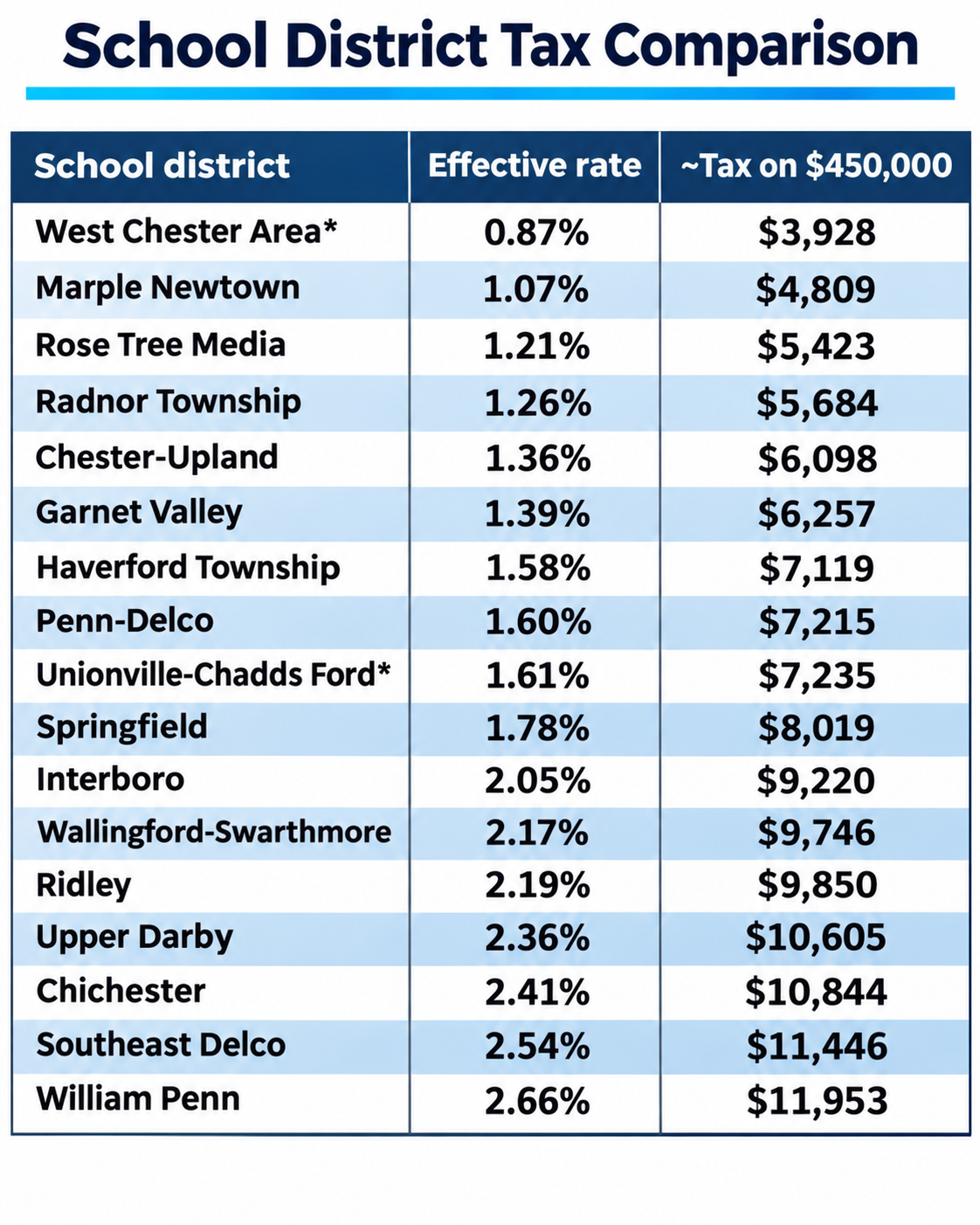
*West Chester Area and Unionville-Chadds Ford are based in Chester County; the figure is the rate on the Delaware County homes they cover.
Data: 2026 county and municipal millage, 2025–26 adopted school millage, and the state's 2025 Common Level Ratio (54.64%), compiled from the Delaware County assessment office and NookLocal's effective-rate analysis. These rates change every year — confirm the current figure for a specific home before relying on it.
Why "lowest millage" is the wrong way to compare
If you just Google millage rates, Delaware County's numbers look oddly low next to Chester or Montgomery County. That's not because the taxes are lower — it's because of how Delco assesses.
Delaware County did a countywide reassessment in 2021 and reset every home to its market value that year. Prices have climbed since, so the state now pegs assessments at about 54.64% of today's value (that figure is the Common Level Ratio). Because the millage applies to those bigger, more current assessments, the raw millage number looks smaller — but the actual bill isn't.
The honest way to compare is the effective rate: millage converted through that ratio into a plain percentage of what your home is really worth. That's what the ranking above uses, and it's the only number that lets you compare one district — or one county — to another.
One more thing the ranking smooths over: your bill has a municipal piece too, and municipal millage varies a lot from town to town inside the same district. So two homes in the same school district, in different boroughs, can have noticeably different bills. The district gets you close; the specific town gets you the real number.
The low-tax districts buyers ask about most
Setting aside the two Chester County-based districts that only clip a sliver of Delco, here are the lower-rate districts buyers ask me about, with towns you'll recognize:
Marple Newtown (around 1.07%) — covers Broomall and Newtown Square. The lowest full-district rate in the county.
Rose Tree Media (around 1.21%) — includes Media borough and the surrounding townships.
Radnor Township (around 1.26%) — the Main Line, including part of Wayne.
Garnet Valley (around 1.39%) — Garnet Valley and Glen Mills, popular with move-up buyers.
Haverford Township (around 1.58%) — just above the middle, but a perennial favorite.
A fair word of caution: the lowest tax rate isn't automatically the "best" choice. A rate is just one number, and it doesn't tell you about school performance, local services, home prices, or commute. A couple of lower-rate districts on the list are lower for reasons that have nothing to do with being a bargain — so look at the whole picture, not just the tax line. I always tell buyers to weigh the tax rate alongside the things that actually shape daily life, and to research school quality directly through Pennsylvania's state performance data for the specific district. Taxes are one input into the decision, not the decision.
What actually drives your bill (and how to lower it)
Your Delaware County tax bill is three millage rates stacked together:
County — 4.609 mills for 2026, the same for everyone in the county
Municipal — set by your town or borough, and it varies widely
School district — the biggest piece, often 70% or more of the total
That's why the school district drives this conversation — it's the largest lever on your bill. But a couple of things can lower what you actually pay:
The Homestead/Farmstead Exclusion. If the home is your primary residence, this reduces the school portion of your bill. It's not automatic — you apply through the county after you buy, and plenty of owners forget to.
The town you pick within a district. Since municipal millage varies, choosing one borough over another in the same school district can meaningfully change the bill.
Watching your assessment after you buy. Pennsylvania doesn't reassess a home just because it sold, but if you pay well above a home's assessed value, a school district can file an appeal to raise it. (I wrote a separate post on how that works — worth reading if you're buying above assessment.)
The practical move: once you've narrowed down a district, get the real number for the specific home and town, not the district average.
Frequently asked questions
Which Delaware County school district has the lowest property taxes? Among districts that run their own schools and are based in Delaware County, Marple Newtown has the lowest effective rate, around 1.07% of market value — roughly $4,809 a year on a $450,000 home. (A sliver of the county in Chester County's West Chester Area district is technically lower.)
Which district has the highest? William Penn, at about 2.66% of market value — roughly $11,953 a year on a $450,000 home. The gap between the lowest and highest full-district rates is around $7,000 a year on the same-priced home.
Why does Delaware County millage look so low compared to other counties? Because Delco reassessed in 2021 and taxes off those current values. Other counties often tax off decades-old assessments and use much higher millage to compensate. Comparing the effective rate — the percentage of real market value — fixes that distortion.
Do lower property taxes mean a worse school district? Not necessarily. Tax rate and school quality are related but not the same thing. Some low-rate districts are highly regarded; others are low for different reasons. Always check the district's actual school performance separately before deciding.
How do I find the exact taxes on a specific home? You need the home's assessed value and the combined county, municipal, and school millage for that exact town. I'm glad to run the real number on any property you're considering.
This is general information, not tax advice — rates change annually, so confirm the current figures with the county and district.
Want the real number on a specific home?
District averages are a great starting point, but your actual bill comes down to the exact home, town, and assessment. If you're house-hunting in Delaware County and want to understand what you'll really pay — or you're weighing a couple of districts against each other — I'm glad to run the numbers with you.
Call or text me directly at 484-744-4053 and we'll figure out the real picture for the homes you're looking at.