Can You Buy a New House Before Selling Your Current One?
Oct 15, 2026 · @William Holder
Yes — you can buy a new house before selling your current one, and plenty of move-up buyers do exactly that. The two real questions are whether you can qualify to carry both homes for a stretch, and how you'll tap the equity that's currently locked up in your house.
Solve those two, and the rest is strategy: buy first for the convenience, or sell first for the strongest position. Here's how to think it through.
Can you actually do it? What it really takes
Buying before you sell comes down to two hurdles. Clear both and you have options; miss one and it gets hard fast.
1. Qualifying to carry both homes. Until your current house sells, a lender may count both mortgage payments against you. Some buyers qualify comfortably; others are too tight on debt-to-income to hold two payments at once. The first call to make is to a lender who can tell you exactly where you stand — before you fall in love with a new house.
2. Getting to your equity. Most of your buying power is probably locked inside your current home. The whole game of buying first is finding a way to use that equity for a down payment before the sale actually closes. That's what the options below are really about.
One more reality worth naming up front: with rates in the 7s as of October 2026, carrying two homes — even briefly — costs more than it did a few years ago. That doesn't make it a bad idea. It just means the plan has to be tight.
Your main options to buy first
There's no single "right" way — the best fit depends on your equity, your income, and how much certainty you want. Here are the common routes:
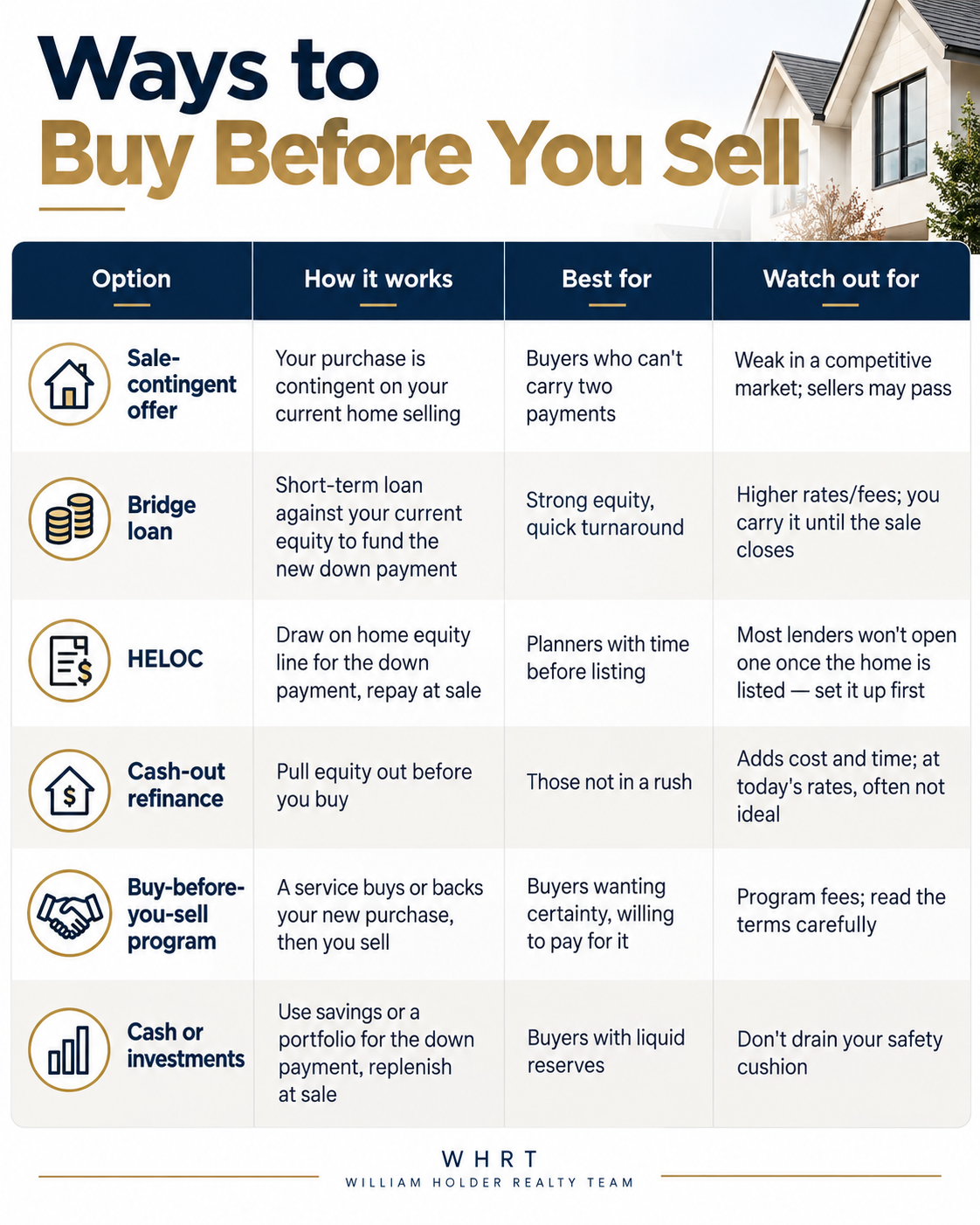
The thread running through all of these: set the financing up before you start shopping. The HELOC point especially — open it while you still can.
Buy first or sell first? The real tradeoff
Strip away the financing details and it comes down to convenience versus leverage.
Buying first means no double move, no scramble for temporary housing, and time to find the right home instead of grabbing whatever's available. The cost: you may carry two payments for a while, and you're taking on financing risk if your home sells slower than expected.
Selling first gives you the strongest position — you know exactly how much you have to spend, and you shop as a non-contingent buyer, which sellers love. The cost: if your home sells before you find the next one, you may need a rent-back or an interim place to land.
There's no universally right answer. It depends on your finances, your risk tolerance, and how tight the inventory is for the kind of home you're chasing — which, around here, is the part people underestimate.
The Delaware County reality (and how to make a contingent offer work)
Tight inventory cuts both ways for move-up buyers here, and you have to plan for both edges.
The hard edge: in sought-after towns like Wallingford, Swarthmore, Media, and Garnet Valley, good homes get multiple offers. A sale-contingent offer is the weakest one on the table, and in a bidding war it usually loses. So "just make it contingent" often isn't a real plan in the neighborhoods people most want to move up into.
The helpful edge: that same tight market means your current home, priced right, should sell quickly once it hits the market. That speed is what makes buying first far less risky than it sounds — you're not carrying two homes for months, usually just weeks.
If you do need your offer to lean on a sale, here's how to make it as strong as possible:
Get your current home fully list-ready before you shop — photos done, price set, ready to launch within days
Line up your financing (bridge or HELOC) ahead of time so you have a non-contingent backup
Come in with a strong pre-approval and flexible timing for the seller
Price your own sale to move, not to test the market
Consider offering the seller of your new home a short settlement, and ask for a rent-back on your sale so the timing lines up
The buyers who pull this off smoothly aren't lucky — they're the ones who set the whole sequence up before making a move.
Frequently asked questions
Can I qualify for a second mortgage before selling my first home? Sometimes — it depends on your income and total debt. A lender can run the numbers and tell you whether you can carry both payments, or whether you'll need your sale to close first. That's the first call to make.
What is a bridge loan, and should I use one? It's a short-term loan against your current home's equity that funds the down payment on your new one, repaid when your home sells. It's useful when you have strong equity and want to buy without a sale contingency, but it carries higher costs, so it's worth comparing against a HELOC.
Can I use a HELOC to buy before I sell? Yes, but timing is everything: most lenders won't open a HELOC once your home is listed. If this is your plan, set the line up before you put the house on the market.
Will a contingent offer get accepted in this market? It can on a home that's been sitting, but in competitive Delaware County towns it's usually the weakest offer in the room. Having financing lined up so you can drop the contingency is what makes the difference.
Is it smarter to buy first or sell first? Sell first for the strongest buying position and a known budget; buy first to avoid a double move and a rushed purchase. The right call depends on your finances and how fast homes are moving in your price range.
Let's map out your move
Buying before you sell works best when the whole sequence is planned in advance — the financing, the timing, and the order of operations. If you're thinking about moving up in Delaware County or anywhere across Delaware and South Jersey, I'm glad to look at your equity and your options and build a plan that fits your situation.
Call or text me directly at 484-744-4053 and we'll figure out the smartest path for you.